
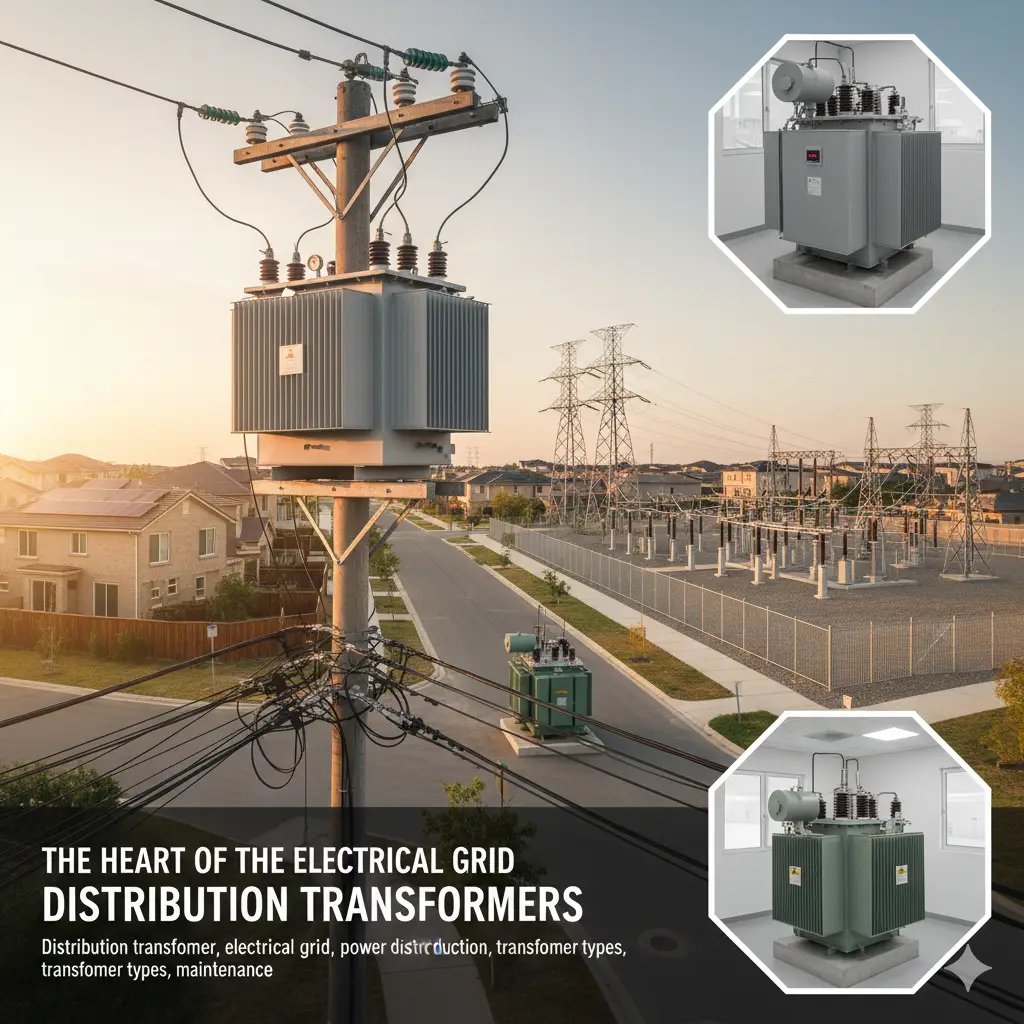
The Heart of the Electrical Grid: An Introduction to Distribution Transformers
The distribution transformer is a crucial component of any electrical power system. It’s the final link in the long journey of electricity from the power plant to your home or business. Its primary job is to step down the high voltage from the transmission and sub-transmission lines to a lower, safer voltage that can be used by end consumers. Without these transformers, the high-voltage electricity would be incredibly dangerous and unusable for most applications.
How They Work and Why They’re Essential
Electricity is generated at power plants and then transmitted across vast distances at very high voltages (e.g., 115 kV to 765 kV) to minimize power loss. However, this voltage is far too high for residential or commercial use. This is where the distribution transformer comes in. It takes the medium-voltage electricity (typically 2.4 kV to 34.5 kV) from the local substation and reduces it to the standard low voltage used in homes (e.g., 120/240 V in North America or 230/400 V in Europe).
The fundamental principle behind its operation is electromagnetic induction. A transformer consists of two or more coils of wire, called windings, wrapped around a magnetic core. The primary winding is connected to the incoming high-voltage line, and the secondary winding is connected to the load (your home). When alternating current flows through the primary winding, it creates a fluctuating magnetic field in the core. This magnetic field, in turn, induces a voltage in the secondary winding. The ratio of the number of turns in the primary winding to the number of turns in the secondary winding determines the voltage transformation ratio. Since distribution transformers are “step-down” transformers, they have more turns in the primary winding than in the secondary.
Key Components
A typical oil-filled distribution transformer is comprised of several key parts:
Core and Windings: The heart of the transformer, where the electromagnetic induction occurs. The core is often made of laminated steel to reduce energy losses.
Insulating Fluid (Transformer Oil): This oil serves two vital functions: cooling the windings and providing electrical insulation to prevent short circuits.
Tank: A sealed container, usually made of steel, that houses the core and windings and contains the insulating oil.
Bushings: Insulators that allow the primary and secondary wires to pass through the tank without touching the metal frame.
Cooling Fins/Radiators: External fins that help dissipate heat from the transformer oil.
Types of Distribution Transformers
Distribution transformers come in various types, depending on their application and installation method:
Pole-Mounted Transformers: The most common type, often seen on utility poles, serving a small number of homes or a single commercial building.
Pad-Mounted Transformers: Used in underground electrical systems, these are low-profile green or grey boxes on a concrete pad, typically found in residential subdivisions. They are designed to be tamper-resistant for safety.
Substation Transformers: Larger transformers located within a substation, they handle a much higher power capacity and step down high transmission voltages to a lower sub-transmission level before they are further distributed by smaller transformers.
Dry-Type Transformers: These transformers don’t use oil for cooling or insulation. Instead, they rely on air or other gases. They are often used in indoor applications where fire safety is a concern, such as in schools or hospitals.
Maintenance and Future Trends
Like any piece of equipment, distribution transformers require regular maintenance to ensure reliability and a long lifespan. This includes periodic inspections, oil quality testing, and cleaning. The lifespan of a distribution transformer is typically around 30 to 40 years, but with proper care, they can last even longer.
The future of distribution transformers is tied to the evolving electrical grid. With the rise of renewable energy sources like solar and wind, and the increasing adoption of electric vehicles, transformers are being subjected to more dynamic and complex loads. This has led to the development of smart transformers equipped with sensors and communication capabilities that allow for remote monitoring and control, enabling more efficient and resilient power distribution.