

In the modern landscape of urban and suburban development, a seemingly unassuming green or gray metal box sitting on a concrete pad is a familiar sight. This is a pad-mounted transformer, a critical component of the electrical distribution system that plays a vital role in delivering safe and reliable power to our homes, businesses, and communities.
What Is a Pad-Mounted Transformer?
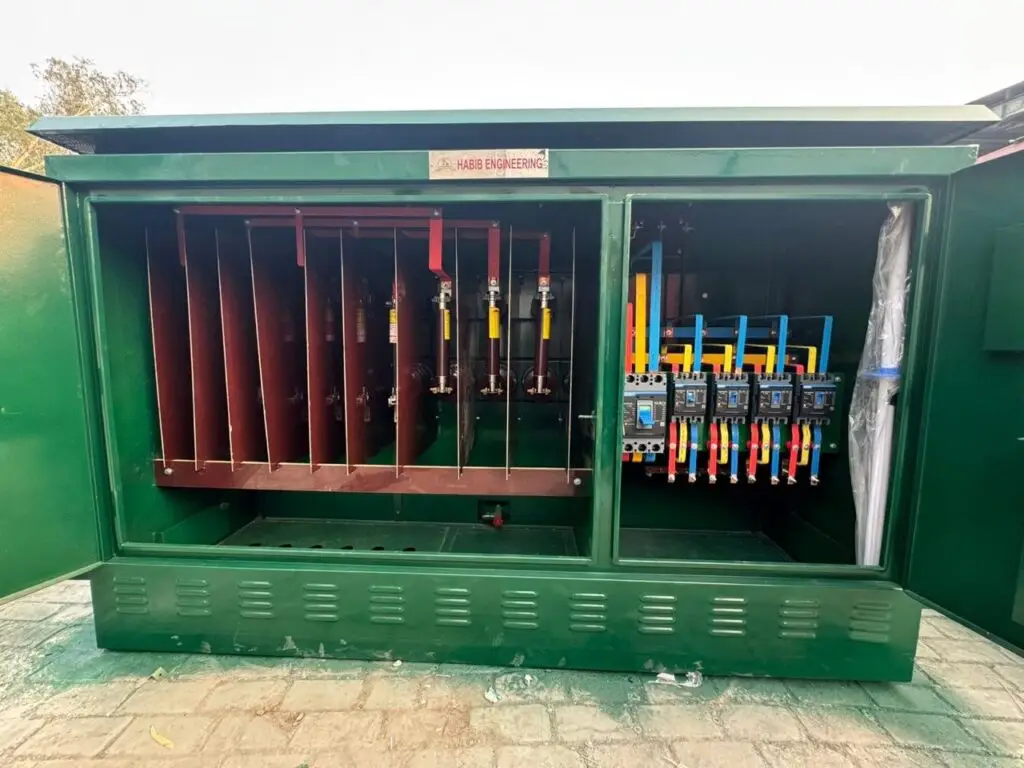
A pad-mounted transformer is an electric power distribution transformer that is installed at ground level on a concrete pad. It is encased in a locked, weatherproof steel cabinet that houses all the energized components. This “dead-front” design, where all live connections are fully enclosed, makes it a safe alternative to traditional pole-mounted transformers, as it can be installed in public areas without the need for a protective fence.
These transformers are primarily used with underground electrical distribution systems. They take high-voltage electricity from a primary utility line and “step it down” to a much lower, usable voltage for customers. A single pad-mounted transformer can serve a single large building, a block of homes, or an entire commercial complex.
How They Work
The operation of a pad-mounted transformer is based on the principle of electromagnetic induction. High-voltage electricity from the grid enters the transformer’s primary winding. As this current flows, it creates a magnetic field that fluctuates with the alternating current. This fluctuating magnetic field then induces a lower voltage in the secondary winding. The secondary winding is connected to the customer’s electrical system, providing power at a safe and usable voltage (e.g., 120/240V for residential use or 208/480V for commercial applications). The entire process occurs within the sealed, oil-filled tank inside the metal cabinet, which helps to cool the transformer and provide insulation.
Key Types and Configurations
Pad-mounted transformers come in various types to meet specific application needs. The primary distinctions are:
- Single-Phase vs. Three-Phase:
- Single-phase transformers are used for residential neighborhoods and small commercial buildings with lower power requirements.
- Three-phase transformers are larger and are used in industrial, commercial, and large residential complexes that require higher power loads for heavy machinery, HVAC systems, and other equipment.
- Radial vs. Loop Feed:
- Radial feed transformers have a single primary line coming in, which is a simpler and more cost-effective design, typically used in residential areas.
- Loop feed transformers have two incoming primary lines, creating a continuous loop. This provides redundancy, so if one line fails, the other can still supply power, which is critical for reliability in commercial and industrial settings.
- Dead-Front vs. Live-Front:
- Dead-front transformers have all high-voltage connections fully insulated with no exposed live parts, which is the standard for safety in public areas.
- Live-front transformers have exposed high-voltage bushings that are only accessible to qualified personnel and are used in more secluded or controlled environments.
Applications and Advantages
The use of pad-mounted transformers has grown significantly due to their many benefits:
Applications
- Residential Developments: They are the standard for modern neighborhoods with underground power lines, providing power without the visual clutter of overhead wires and poles.
- Commercial and Industrial Sites: Shopping centers, hospitals, factories, and office parks rely on pad-mounted transformers for a stable and secure power supply.
- Renewable Energy: They are used in solar and wind farms to step up the voltage before the power is fed into the main electrical grid.
Advantages
- Safety: The fully enclosed, locked cabinet and “dead-front” design prevent accidental contact with energized parts, making them ideal for public spaces.
- Aesthetics: They are low-profile and can be discreetly placed in landscapes, avoiding the visual intrusion of overhead power lines and large fenced-in substations.
- Durability and Reliability: Built to withstand harsh weather and external damage, they provide a long service life with minimal maintenance.
- Space-Saving: Their compact design eliminates the need for large, fenced enclosures, making them perfect for urban and suburban areas where space is at a premium.
Sources
